
Not Imperfect, But Incomplete.
A reflection on Schopenhauer's representation, will, and how we've mistaken incompletion for imperfection.

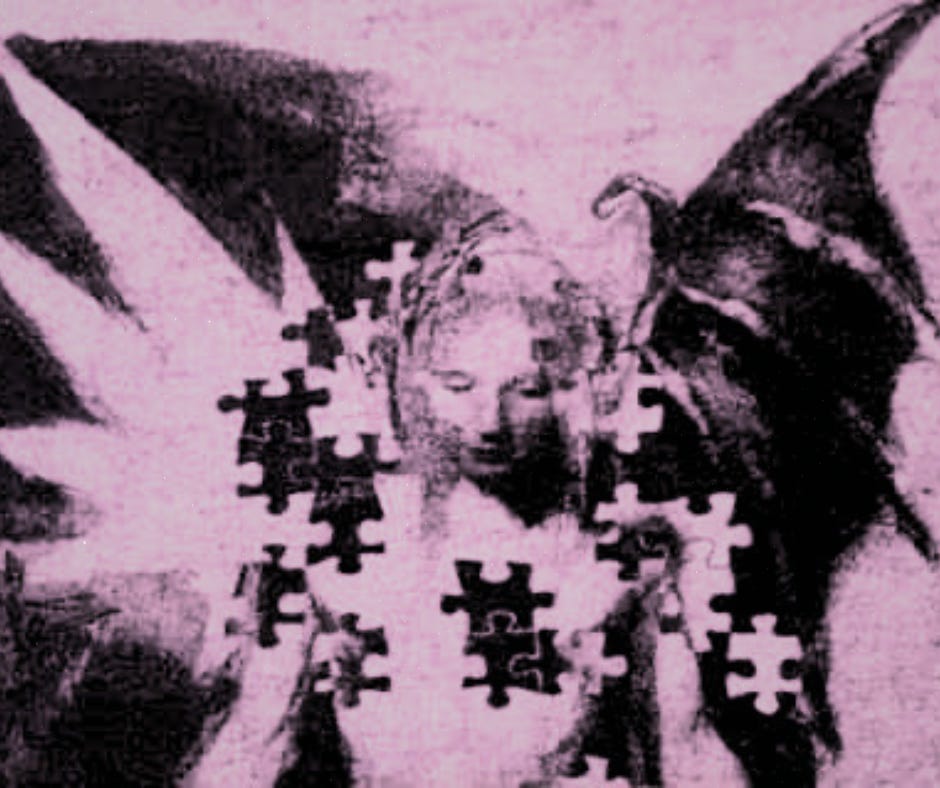
Numerous auroras ago, human beings developed a strong flair for detecting what could be considered a “flaw” as a mechanism of survival: rotten food, instability or a potential danger… and perhaps, through this evolutionary propensity, combined with the synergy between innate human characteristics and modern cognition, emerged the constant human awareness of what is lacking.
An awareness still as persistent as ever, to the point that it eventually evolved into a mania where perfection becomes the axis and mankind draws near like an asymptote (or attempts to).
But nobody’s perfect—or at least that’s what we've always been told… right?
Though I started wondering whether we have mistaken incompletion for imperfection.
As a matter of fact, the same force suspending cosmic systems in such meticulous mathematical precision also formed us from nebular dust. Hence where and when does that so-called imperfection begin?
This makes one question how could a universe capable of producing such intricate architecture suddenly create fundamentally flawed beings, and whether there is (or not) some kind of contradiction within that assumption?
It could be that the answer lies within language itself. This rudiment of human understanding has the power to reveal underlying connotations often concealed by collective consciousness, because in Arabic, perfection and completion nearly merge into the same semantic root. There is no word exclusively attributed to perfection instead, the term “الكمال” (Al Kamal) refers to completion or fullness. The full moon, for instance, is described as قمر مكتمل (Qamar Muktamil); thus a “completed” moon.
Which might means that, more often than not, we have been confusing perfection with completion.
It's not that we are imperfect. Maybe we are simply incomplete, and that incompletion is intentional.
For a deeper exploration of how language shapes collective consciousness, read the essay below :
I Speak, Therefore I Am.

Leon Tolstoy once critiqued art that is disconnected from the common experiences and feelings of people, suggesting that such art struggles to communicate effectively. Art, in his view, only truly resonates when it is rooted in shared cultural understanding
A puzzle piece is useless when perfectly smooth. If every piece of the game were to be symmetrical or identical, there would be no such a thing as puzzle anymore. And if hypothetically polished into near atomic flatness, there’s a slight possibility the pieces might even turn into mirrors and reflect one another, like chroniclers of Narcissus’ scintilla until all vanish but the self.
A puzzle piece fulfills its purpose because of its irregularities, (or its incompletions)—the parts that seem to be “missing”
But i doubt it’s a missing part if a piece contains an emptiness so another may complete it. It's not an imperfection if the incompletion is correlated with space and time variables, nor accidental because without that specific shape each piece has, no image could ever emerge.
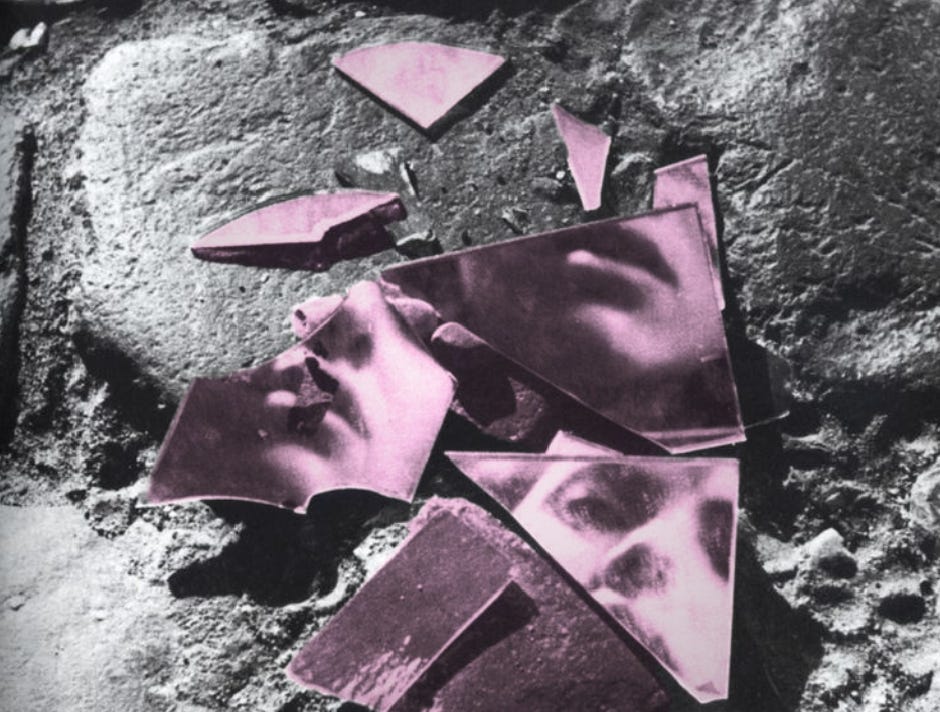
Peradventure we, as human beings, are no different than puzzle pieces.
Schopenhauer’s distinction between Vorstellung (representation) and Wille (will) suggests that what we experience is only a constructed representation of reality and that beneath it lies a “noumenal”1 one that drives all existence.
It could be that incompletion is not a flaw in our being but a deterministic condition that allows existence to relationally unfold, that we are spending way too much time grieving the unfinished parts of ourselves without realizing that our incompletion is what allows us to connect, evolve, and belong to something greater than whatever our perception has shaped of this world.
What we consider an imperfection may actually be the embodiment of interdependence and complementarity—a Heideggerian entanglement in which being is never separate from the world it inhabits, rather, a part of it, ceaselessly manifesting through its elements.
And while we oscillate between representation and will, we are also intrinsically contributing to the wonderful architecture of our universe, from dust to ashes and everything in between.
© 2026 ashndust. All rights reserved.
The noumenon is a Kantian concept, in contrast to the phenomenon, it refers to objective reality prior to the intervention of perception. The term “noumenal” was used here in the Kantian sense to characterize Schopenhauer’s Wille as a reality underlying representation.
I loved this - incompletion is often the key to the deepest parts of the self. What exhausts is not the process, but the fixation that the ideal must be achieved. It’s a bit like language: mastery is only an ideal, like a god we yearn for but never touch. Maybe the point is not to reach heaven, to master a language, or to finish the puzzle - but to stay with the precise moment of transformation.
Wonderful. I’ve studied philosophy and thought much about the notion of the noumenon. I’ve struggled to accept its reality. It seemed to be too beyond us to be of any relevance to our lives. But this gave me a different perspective.